
In April 1456, three mercers’ servants (probably journeymen) saw a Lucchese merchant, Alessandro Palastrelli, on Cheapside with a dagger hanging ostentatiously from his belt. Tensions in England were high that year; beyond the developing civil war, another flashpoint was Londoners’ resentment towards Italian merchants, who (in their view) undercut the English and in general actedContinue reading “Tensions with Italian merchants”
Author Archives: shannonmcsheffrey
False Confessions
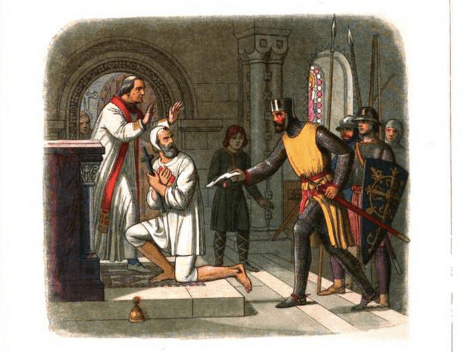
On 25 July 1457, Richard Grene of Lincolnshire was travelling on the king’s highway from the Louth fair when a stranger attacked him and threatened his life. He fled to a sanctuary, but his enemies appeared and tried to drag him out. To stop them, he called for the coroner, falsely confessed he’d been presentContinue reading “False Confessions”
“Girthmen,” religious processions, and sanctuary at Ripon
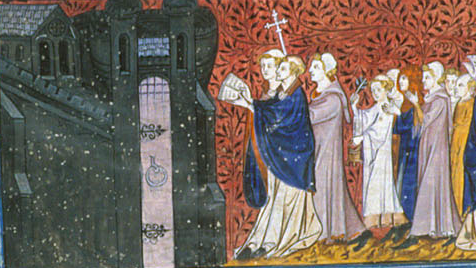
In 1458, six sanctuary men (“gyrthmanii”) at Ripon Minster in Yorkshire were censured for not participating in the minster’s Rogation procession, in which parishioners ritually paraded around a parish’s boundaries to mark them out. The “Girthmen” T. Plumer, R. Morton, E. Skathlok, J. Skathlok, H. Jonson, and W. Topshawe – probably all debtors – explainedContinue reading ““Girthmen,” religious processions, and sanctuary at Ripon”
Seizure from sanctuary at Ely cathedral

In 1459, Cambridgeshire officials were pursuing felon Henry Mullyng when he darted into Ely cathedral and took sanctuary. The officers, led by gentleman and Justice of the Peace John Ansty, seized Mullyng from the church and took him into custody. The bishop of Ely, William Grey, wasn’t going to stand still for a breach ofContinue reading “Seizure from sanctuary at Ely cathedral”
What was he thinking?

Here’s an odd case. Richard Wode, mercer of Worcester, took sanctuary at St. Mary’s in Newington, Surrey, in 1460. He confessed to the coroner that he had stolen a horse from Angelo Spynell, merchant of Genoa, at Southampton. The coroner asked if he wanted to abjure the realm, but Wode said he would instead stayContinue reading “What was he thinking?”
Could a house serve as sanctuary? Hospitallers and asylum in the 15th century
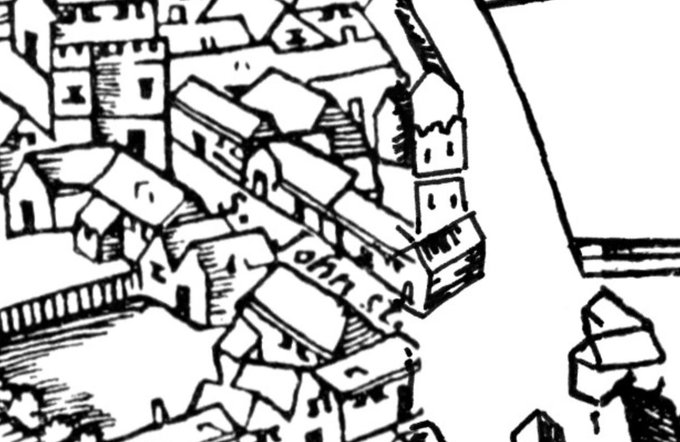
In 1461 a coroner’s inquest was held over the body of William Lyng, found dead in St John’s Street, which led into the priory of St John of Jerusalem, the Hospitaller Knights’ HQ in Clerkenwell. The inquest jurors ruled that Lyng was killed by Vincent Hall, baker and brewer of St John’s Street. Hall wasContinue reading “Could a house serve as sanctuary? Hospitallers and asylum in the 15th century”
Abduction and women’s agency: Elizabeth Venour, warden of the Fleet Prison

This one is a doozy. In 1461, Elizabeth Venour’s husband William died. William had held, through Elizabeth’s inheritance, a lucrative gig as warden of the Fleet Prison for debtors, just west of London. On her husband’s death, Elizabeth retained the wardenship (and acted in that capacity – an unusually public role for a woman) andContinue reading “Abduction and women’s agency: Elizabeth Venour, warden of the Fleet Prison”
Sanctuary at Pembroke College, Oxford?

After stabbing someone with a “little knife” one day in August 1463, John Harry, a tailor of Oxford, fled to Broadgates Hall, now part of Pembroke College, then a residence hall for law students at the university. Harry claimed sanctuary there, as the hall belonged to the Hospitallers, which according to the Acts of theContinue reading “Sanctuary at Pembroke College, Oxford?”
Failed insurrection in sanctuary

Although sometimes sanctuaries were portrayed as cradles of sedition, in a 1463 case it appears that sanctuary seekers themselves resisted (and reported) an attempt to stoke them into rising. A Middlesex jury charged with reporting local crime and disorder noted that a sanctuary man named John Coydon, resident in the Westminster Abbey precinct, had toldContinue reading “Failed insurrection in sanctuary”
Overstaying 40-day sanctuary
There were established rules for what to do if a sanctuary seeker refused to abjure and leave sanctuary in a parish church after 40 days, but not everyone who dealt with such cases knew those rules – or wanted to follow them. So it was with Thomas White, who took sanctuary at St. Mary IncombustaContinue reading “Overstaying 40-day sanctuary”
 Sanctuary Seekers in England, 1394-1557