
In the late 1440s, Edward Wyrley was arrested in Westminster for felony and taken to prison to await trial, but somehow escaped and ran into Westminster sanctuary. Wyrley claimed he was then forcibly removed from the precinct and brought back to stand trial. Felons thus seized could “plead sanctuary,” i.e. asking the court to restoreContinue reading ““Pleading sanctuary” in court”
Tag Archives: Execution by hanging
Bagpipes and cheese: an unsuccessful burglary
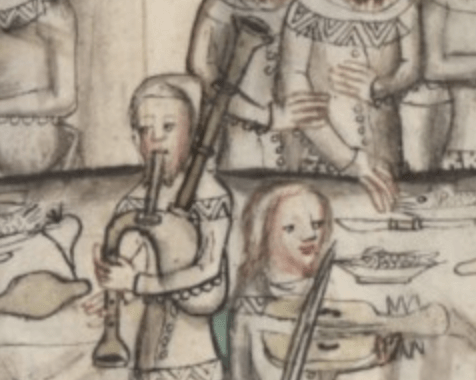
Who amongst us has not had the urge to steal a set of bagpipes and eight large cheeses? Basic party kit, as presumably John Esteneys, a weaver from Southwark, thought when he broke into two houses in Walton on Thames in 1451 to steal those items. The party apparently went wrong, however, and on 28Continue reading “Bagpipes and cheese: an unsuccessful burglary”
What was he thinking?

Here’s an odd case. Richard Wode, mercer of Worcester, took sanctuary at St. Mary’s in Newington, Surrey, in 1460. He confessed to the coroner that he had stolen a horse from Angelo Spynell, merchant of Genoa, at Southampton. The coroner asked if he wanted to abjure the realm, but Wode said he would instead stayContinue reading “What was he thinking?”
Sanctuary for sexual assault

On 12 March 1467, John Beauchamp of Lympstone, Devon, took sanctuary at St. Paul’s cathedral in London because eight years before he had assaulted, raped, and “deflowered” singlewoman Alice Perow with a knife. By the way, although in some circumstances in the 15th century (as Ruth Mazo Karras has shown), “singlewoman” came to be usedContinue reading “Sanctuary for sexual assault”
An abjurer found in the realm

At the end of March 1480 John Bere, a cutler from Bristol, took sanctuary at the parish church at Water Lambeth, Surrey, across the Thames from Westminster. Bere confessed to the coroner that more than three years before, just before Christmas 1476, he had murdered a certain Richard Hylles at Sampford Peverell, Devon. He choseContinue reading “An abjurer found in the realm”
A petty thief hanged

On 4 April 1481, Richard Aleyn, yeoman of Wimborne Minster, Dorset, took sanctuary in Winchester Cathedral: his is an all-too-typical story of what seems outsized consequences for small-scale theft. Aleyn confessed to the coroner that a week before he’d broken into John North’s house at Gulford in Wiltshire and stolen 12 yards of woolen cloth,Continue reading “A petty thief hanged”
Last-minute reprieve

Here’s a drama! On 28 April 1481 Geoffrey Gwynnyth, yeoman of London, took sanctuary in St George’s church in Southwark, confessing to the coroner that he had stabbed John Sander at Tottenham in 1478, killing him. Gwynnyth abjured the realm, and was to leave by Dover; a week later, however, he had been found inContinue reading “Last-minute reprieve”
Ordinary life in political chaos

In the midst of political chaos, ordinary and unconnected crises in people’s lives continued. On 12 June 1483, a sawyer from London named John Stokes took sanctuary at the parish church of St. Mary in Reading. Mid-June 1483 was a time of high drama in England: Stokes sought sanctuary just as Richard, duke of Gloucester,Continue reading “Ordinary life in political chaos”
Murder and horse theft, 1483

William Savage, a skinner of Sandwich, Kent, took refuge at St Botolph without Aldgate in London on 23 September 1484. Savage confessed to the coroner that on 12 April 1483 at Winchester, he killed chapman John Brande and stole his horse. This is maybe irrelevant, but he committed this crime only three days after EdwardContinue reading “Murder and horse theft, 1483”
Abjurer found in the realm, 1486
In July 1485 John Walworth, yeoman of Weston, Northants, assaulted Hugh Peke at Clifton in Nottinghamshire, killing him. Six months later, Walworth took asylum at the parish church of St. Andrew in Kingston, Cambridgeshire. Walworth abjured the realm, but by the fall of 1486 he had been found in London: probably he hoped the anonymityContinue reading “Abjurer found in the realm, 1486”
 Sanctuary Seekers in England, 1394-1557