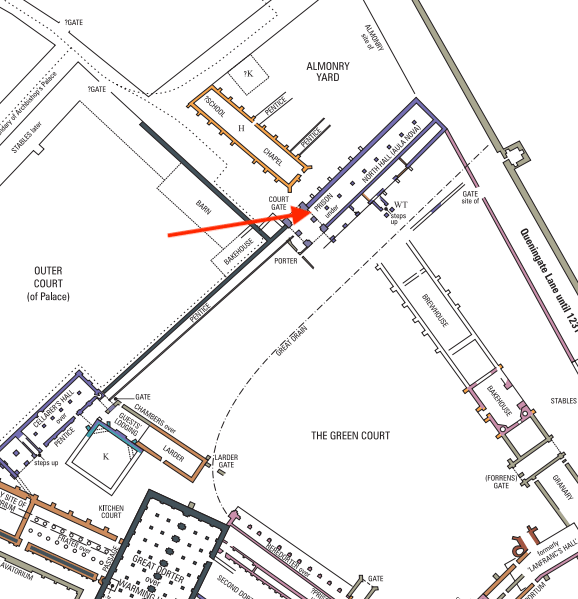
In March 1418, Peter Hughebard, labourer of Woodchurch, Kent, was arrested for theft and put into the prison of Christchurch cathedral priory in Canterbury (presumably because he had been arrested within the liberty of the priory). Though we don’t usually think about churches as needing prisons, English bishops and other ecclesiastical leaders often acted asContinue reading “Escape from the bishop’s prison”
Tag Archives: Homicide
Serial sanctuary seeker runs out of luck

Some people took sanctuary more than once — but in this case, the double sanctuary-seeker still ended up on the gallows. In 1425, John Holand, a shoemaker from Stone, Staffordshire, took sanctuary at the parish church in Hackney. He told the coroner that he, together with two soldiers and a horse-dealer, had murdered a LondonContinue reading “Serial sanctuary seeker runs out of luck”
Inventing a felony to escape a creditor?
In 15th-century England, if you couldn’t pay your debts your creditors could throw you in prison until you were able to pay them off: no bankruptcy declarations, no restructuring, just a rather counter-productive carceral stint. Prisons were unpleasant, to say the least, so of course you’d do what you could to avoid that arrest, especiallyContinue reading “Inventing a felony to escape a creditor?”
Conspiracy to murder in Gloucester

On 4 November 1426, one Thomas Brugge was attacked and killed at Gloucester. The coroner’s inquest jury reported that Richard Arleston, also of Gloucester, servant, had committed the murder, and that Arleston’s master, John Rede of Gloucester, brewer and constable of the town, along with five of Rede’s other servants, were accessories to murder. TheContinue reading “Conspiracy to murder in Gloucester”
Gentry violence in Lincolnshire, 1427

In 1427 a gentleman in his 50s assembled a small private army to ambush an enemy. The enemy was killed in the affray and the gentleman ran to sanctuary – but then later was acquitted of the charge. He went on (of course) to be an MP and sheriff. On 10 August 1427, a coroner’sContinue reading “Gentry violence in Lincolnshire, 1427”
The long road to sanctuary

Some sanctuary seekers taking asylum in a parish church travelled remarkable distances across the kingdom of England committing crimes and then escaping from the consequences. In the late 1420s, one seeker left his home in Yorkshire seeking work in Northumberland; things went awry at his workplace in Newcastle, however, causing him to flee a murderContinue reading “The long road to sanctuary”
Two-for-one

On 28 May 1429, two fleeing felons, who had committed unrelated crimes but had somehow joined up, took sanctuary together in the parish church of St. Dunstan in Cheam, Surrey. Although the record doesn’t say in their case, in other similar situations the felons had met in prison and escaped together. Jessica Freeman was theContinue reading “Two-for-one”
Domestic homicide, espionage, and women’s vigilante justice

On 27 May 1429 at Whitechapel, Ivo Caret of Brittany murdered his employer, the widow Joan Wynkfeld, and ran off with all her portable goods. Later chroniclers said that Wynkfeld, a wealthy woman, had taken Caret into her home and given him work as an act of charity. This magnanimity was well-intentioned but ill-placed, forContinue reading “Domestic homicide, espionage, and women’s vigilante justice”
Ex-soldiers and violence in the 1430s

Around 1431, an argument broke out on an agricultural estate just outside Rochester in Kent. Two farm servants, thresher William Wynter and ostler William Pope, quarrelled over a belt decorated with silver. Wynter was an ex-soldier, a veteran presumably of the French wars (there are various William Wynters, archer, in http://medievalsoldier.org) and perhaps Pope, too,Continue reading “Ex-soldiers and violence in the 1430s”
A quarrel between two priests

On 19 November 1435, a London chaplain, William Burght, was found dead in the parish of St. Gregory, right by (attached to, really) St. Paul’s cathedral. The coroner’s inquest jurors reported that Thomas Curteys, parson of Shere, in Surrey, had lain in wait to kill Burght, brutally stabbing him many times with a “trencherknife” –Continue reading “A quarrel between two priests”
 Sanctuary Seekers in England, 1394-1557